

We have learned the working principle of a single CCD color camera for imaging. Mosaic filters (also known as Bayer filters) allow each pixel to display only one color among red, green, or blue. But since we want the camera to output three colors of red, green, and blue at each pixel, the processing unit of the camera needs to insert the value of the missing color. You can learn more details in the color interpolation section. The significant advantage of this method is that it can save costs. In addition, the quality of today's single CCD cameras is amazingly good. Therefore, most color cameras use this technology.
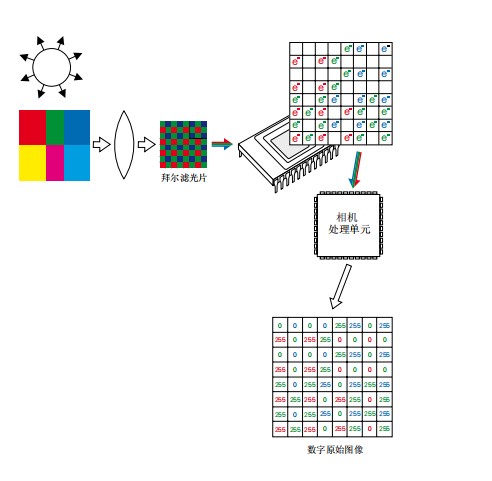
In the field of image applications for measurement purposes,
Color interpolation has major drawbacks: each pixel has red, green, and blue color values, but only one of these three values actually comes from the CCD. The other two values are calculated by interpolation, so they are estimated.
These estimates interfere with the measurement process itself, and they add unnecessary load to the bus and computer. In the field of image measurement applications, we believe that it is more advantageous to turn off color interpolation and directly convert the charge obtained from the CCD into a digital original image.
Note: Most color image processing software now defaults to red, green, and blue values for each pixel. Processing digital raw images is relatively new to most of us. Therefore, we introduce the basic principles of processing digital raw imaging in more detail in the color interpolation section.
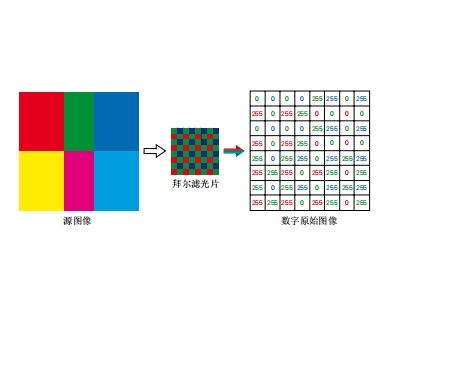
In the previous principle section, we introduced the principle of color interpolation through an example. To make this example simple and clear, the three generated images (the images after the separation of the three colors of the digital original image) are very ideal. Below we will introduce two simple interpolation processes in detail. At the beginning we will use the digital raw images introduced in the section of single CCD camera (measurement) for imaging and measurement. For simplicity, the digital original image, its source map, and Bayer filter are listed below.
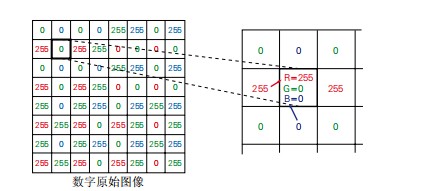
The easiest way to fill in missing color values by copying neighboring pixels (copying of the nearest pixel) is to get color values from neighboring pixels. Let's take the first green pixel (from the Bayer filter) in the second row as an example (as shown by the pixels with a thick black frame on the right).
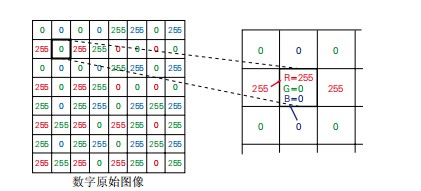
This point is actually red in the source image (see overview), but the color value becomes zero after being filtered by the green pixels of the Bayer filter. We only need to copy the red and blue values of the adjacent red and blue pixels (see the figure on the right) to this pixel to get its RGB value (255, 0, 0). For the example shown on the right, the interpolation method produces the correct RGB value. But in practical applications, for still images, the results generated by this simple interpolation method are unacceptable. However, since it does not take much time, we can use it for video data streams that do not require high quality standards.
Disclaimer: The article "How to select a single CCD camera for imaging and measurement in a video microscope [Nuo Shiqi electron microscope]" comes to the Internet, the opinions expressed in the article do not represent the views of this site, the copyright of the article belongs to the original author, If there is infringement, please contact the webmaster