

The principle of the charge-coupled device (CCD) is simple. We can think of it as a memory chip without a cover. Photons striking memory cells produce electrons (photoelectric effect) in these cells, so the number of photons is proportional to the number of electrons. However, the wavelength of photons has not been converted into electrons. Therefore, CCD chips can be called color blind. Below we will introduce how the color camera works when the CCD chip cannot distinguish colors.
Principle
Start with a monochrome camera
The CCD principle is not complicated. We can think of it as a memory chip with the top open. Therefore, the light beam can hit the memory unit. According to the "photoelectric effect", these beams generate negative charges in the memory cell (upper right part in the right picture). After exposure, these charges are read out and then pre-processed by the camera processing unit. A digital image is output from the camera processing unit. If the camera requires video output in an analog format, we must convert the digital original image accordingly. However, this issue is not related to the "how color cameras work" discussed in this article. We only need to consider the original image in digital format.
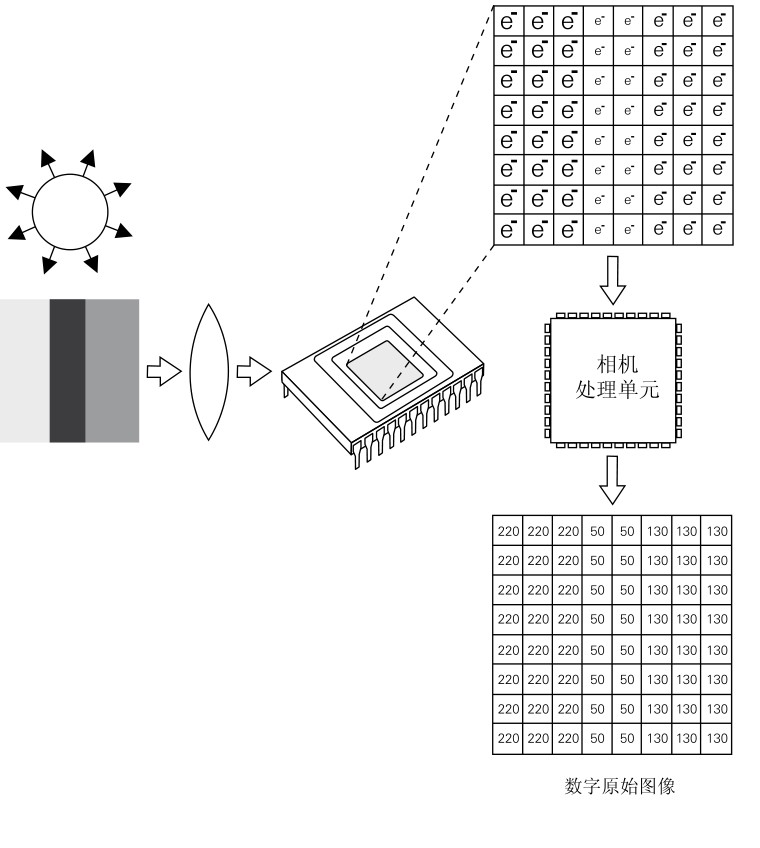
principle
3CCD color camera
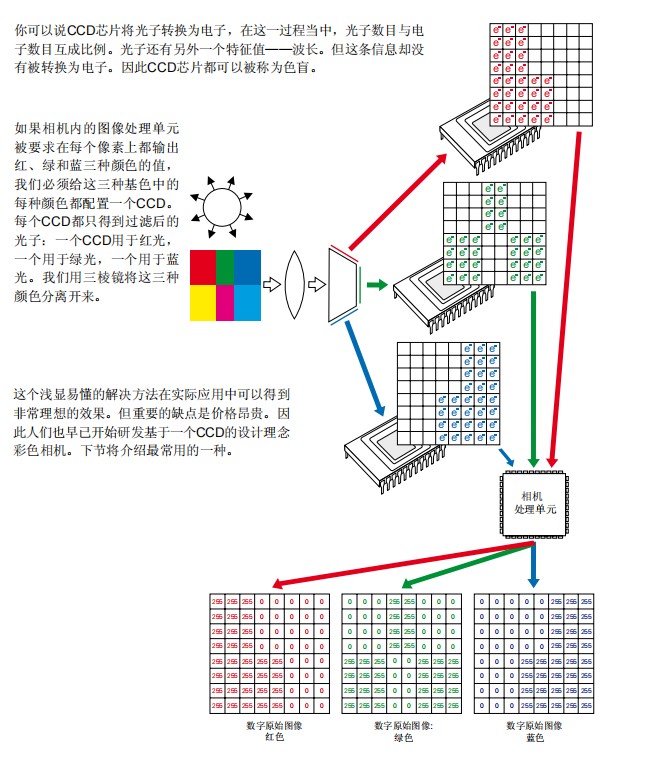
You can say that the CCD chip converts photons into electrons. In this process, the number of photons is proportional to the number of electrons. Photon has another characteristic value-wavelength. But this piece of information has not been converted to electronic. Therefore, CCD chips can be called color blind.
If the image processing unit in the camera is required to output red, green, and blue values for each pixel, we must configure a CCD for each of the three primary colors. Each CCD only gets filtered photons: one CCD for red light, one for green light, and one for blue light. We use a prism to separate these three colors.
This easy-to-understand solution can get very ideal results in practical applications. But the important disadvantage is that it is expensive. Therefore, people have already begun to develop a color camera based on a CCD design concept. The next section will introduce the most commonly used one. ,
principle
Single CCD color camera
If due to price considerations, only one CCD chip can be used, then we have to distribute the color filters on all pixels of the CCD like a mosaic. This concept is also called mosaic filter or Bayer filter (originally invented by Mr. Bayer). In this way, each pixel can only produce one of the three colors of red, green or blue. But at the time of output, all pixels should have the information of these three colors. How should we retrieve these missing values?
The answer is the spatial color interpolation method performed by the camera processing unit. Taking the red pixel in the lower left corner of the right picture as an example, what we need is the missing green and blue values. The interpolation method can estimate these two values by analyzing the pixels adjacent to this red pixel. In this example, we found that the green pixel contains a lot of charge, but the blue pixel has zero charge. So our red pixel is actually yellow. You can find detailed related information in the color interpolation section. If we compare the three digital original images generated by the 3CCD camera with the three digital original images generated by the single CCD camera, we will find that they look exactly the same. But this is only true for our simplified example. In practical applications, even the best color space interpolation method will produce a low-pass effect. Therefore, the image generated by a single CCD camera is more blurry than that of a 3CCD camera or a black and white camera, and it is particularly noticeable for very thin or fiber-type image structures.
This article is edited and created by Shenzhen Nuosiqi Technology Co., Ltd. http://www.cnnooctis.com. Our company will regularly release new product recommendations and product specifications. The company is mainly engaged in high-definition stereo, video, biological, metallographic microscope, industrial camera, industrial lens, industrial zoom lens, industrial light source, machine vision system integration.
Disclaimer: The article "Working Principles of Color Cameras and Measurement Applications of Industrial Cameras on Tool Testers [Nuo Shiqi Electron Microscope]" comes to the Internet. The opinions expressed in this article do not represent the opinions of this site. The copyright of the article belongs to the original author. If there is infringement , Please contact the webmaster of this site